
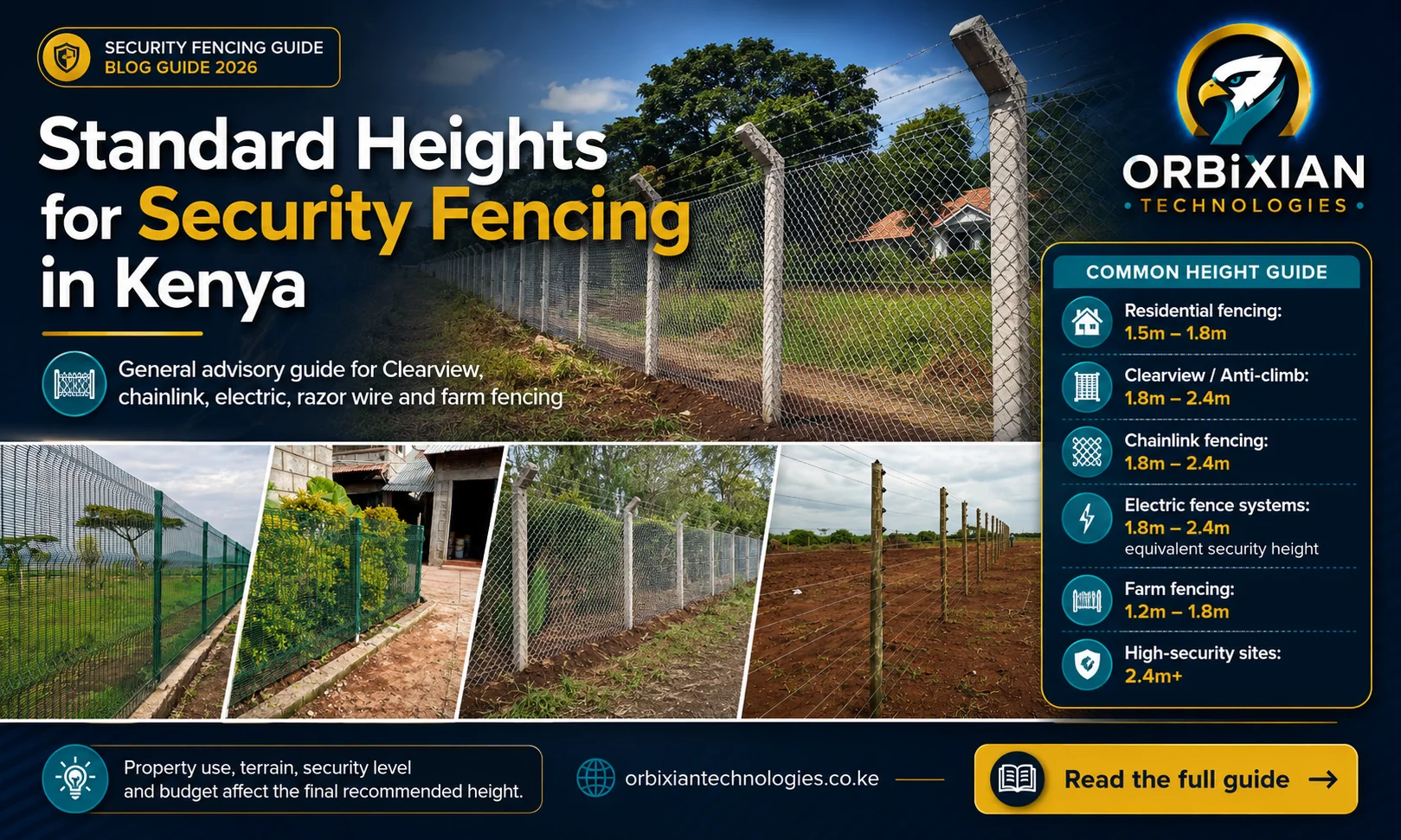
Standard Heights for Security Fencing in Kenya
Standard heights for security fencing in Kenya depend on the type of property, the level of security required, the fencing material, the location, the budget and the final purpose of the perimeter. A residential home, school, farm, warehouse, factory, gated estate or commercial property will not always need the same fence height. The right height should protect the property, control access, support visibility and give long-term value.
Security fencing is not only about closing a boundary. It is about creating a strong perimeter system that discourages intrusion, protects people and assets, improves property appearance and helps security teams monitor the compound. Whether you are installing Clearview fencing, chainlink fencing, electric fencing, razor wire, farm fencing or wall-top security reinforcement, choosing the correct fence height is one of the most important decisions.
In Kenya, the most common security fence heights are 1.2m, 1.5m, 1.8m, 2.1m and 2.4m. High-security projects may go above 2.4m, especially for factories, warehouses, utility sites, schools, commercial developments and restricted facilities that need stronger perimeter protection.
Why Fence Height Matters
Fence height affects security, cost, appearance, material quantity and long-term performance. A fence that is too low may be easy to climb, cross or damage. A fence that is too high may increase the budget unnecessarily if the property does not require that level of protection.
The right fence height helps you:
- Control access into the property
- Reduce unauthorized entry
- Improve boundary protection
- Support CCTV and guard visibility
- Protect homes, schools, farms and commercial sites
- Improve the appearance of the perimeter
- Plan materials and budget accurately
Fence height also affects the size of posts, depth of foundation, number of clamps, strength of gates, delivery cost and installation labour. That is why height should be selected before final quotation.
1.2m Fence Height
A 1.2m fence is usually suitable for light boundary marking, gardens, internal divisions, animal control or low-risk areas. It is not ideal for serious perimeter security because it can be crossed easily.
This height may work for:
- Garden partitions
- Internal estate sections
- Decorative fencing
- Farm zoning
- Light animal control
- Low-risk boundary marking
For security-focused properties, 1.2m should only be used where intrusion risk is low or where another security layer already exists.
1.5m Fence Height
A 1.5m fence provides better boundary control than 1.2m and is commonly used for residential gardens, estates, internal separations, small compounds and areas where visibility is more important than high security.
This height is suitable for:
- Residential front boundaries
- Internal estate fencing
- Garden fencing
- Low-risk commercial areas
- School internal partitions
- Decorative Clearview fence sections
For Clearview fencing, 1.5m can look clean and modern, especially in estates or commercial spaces where the goal is controlled separation, visibility and appearance. However, for stronger perimeter security, 1.8m and above is usually better.
1.8m Fence Height
A 1.8m fence is one of the most common security fencing heights in Kenya. It provides a practical balance between cost, appearance and perimeter protection.
This height is suitable for:
- Residential homes
- Private compounds
- Small commercial properties
- Schools with moderate security needs
- Estates and gated communities
- General chainlink fencing
- Standard Clearview fence installations
For homeowners, 1.8m is often enough when combined with good gates, proper posts and clear visibility. For chainlink fencing, 1.8m is also common for land boundaries, schools and commercial compounds.
If the property is in a high-risk area, 1.8m can be improved with razor wire, electric fencing or security spikes.
2.1m Fence Height
A 2.1m fence is recommended for properties that require stronger perimeter security. It is higher than standard residential fencing and provides better intrusion deterrence.
This height is suitable for:
- Schools and institutions
- Warehouses
- Commercial properties
- Residential estates
- Factories
- Storage yards
- Industrial compounds
- High-value private properties
For Clearview and anti-climb fencing, 2.1m is a strong choice because it improves security while still maintaining a clean and professional look. It is also suitable for properties using CCTV because visibility through the fence remains clear.
For many commercial and institutional projects in Kenya, 2.1m gives a strong balance between cost and protection.
2.4m Fence Height
A 2.4m fence is commonly used for high-security perimeter projects. It is recommended for properties where strong access control and serious intrusion deterrence are required.
This height is suitable for:
- Factories
- Warehouses
- Logistics yards
- Schools with high security needs
- Government facilities
- Commercial developments
- Industrial properties
- Gated estates
- Utility and infrastructure sites
For Clearview fencing, 2.4m is one of the best options for high-security installations. The height makes climbing more difficult, while the anti-climb mesh design reduces grip points. When combined with razor wire or electric fencing, it becomes a much stronger perimeter security system.
For chainlink fencing, 2.4m can be used where the client needs higher boundary protection, especially for schools, farms, industrial sites and commercial land.
Heights Above 2.4m
Fence heights above 2.4m are used for special security projects. These are not always necessary for ordinary homes, but they may be required for sensitive facilities or properties with serious security risks.
Higher fencing may be used for:
- Industrial plants
- Utility facilities
- Restricted compounds
- High-value warehouses
- Government installations
- Large commercial yards
- Infrastructure projects
When going above 2.4m, the structure needs stronger posts, deeper foundations, better bracing and professional installation. A tall fence with weak posts is not secure. The whole system must be engineered properly.
Recommended Heights by Fence Type
Different fencing systems perform differently depending on height. The right height should match the material and the property use.
Clearview and Anti-Climb Fence Heights
Clearview fencing is commonly installed at 1.5m, 1.8m, 2.1m and 2.4m.
Recommended use:
- 1.5m: estates, gardens, internal boundaries and low-risk areas
- 1.8m: residential homes and standard perimeter security
- 2.1m: schools, commercial properties and institutions
- 2.4m: factories, warehouses, industrial sites and high-security properties
Clearview fencing is effective because of its tight welded mesh and modern appearance. For stronger security, 2.1m or 2.4m is recommended.
Chainlink Fence Heights
Chainlink fencing is commonly installed from 1.5m to 2.4m depending on the site.
Recommended use:
- 1.5m: farms, gardens and light land boundaries
- 1.8m: residential plots, schools and general property fencing
- 2.1m: commercial compounds and institutions
- 2.4m: high-security chainlink installations, schools and industrial sites
Chainlink is cost-effective and useful for farms, construction sites, land boundaries, schools and large perimeters. It can be reinforced with barbed wire, razor wire or electric fencing.
Electric Fence Heights
Electric fencing can be installed as a standalone fence or as an add-on above walls, Clearview fences, chainlink fences or other perimeter systems.
For wall-top electric fencing, the final security height depends on the wall height plus the electric fence bracket height. For example, a 1.8m wall with an electric fence topping can create a stronger perimeter barrier.
Electric fencing is ideal for:
- Homes
- Estates
- Schools
- Farms
- Commercial properties
- Warehouses
- Industrial facilities
Electric fencing is not only about height. It also works as an active deterrent through voltage, alarm integration and visible warning signs.
Razor Wire Fence Heights
Razor wire is usually installed as a top reinforcement on walls, chainlink fences, Clearview fences or industrial security fences.
It is commonly used to improve security on:
- Boundary walls
- Chainlink fences
- Clearview fences
- Industrial fences
- Warehouses
- Commercial properties
- Restricted areas
Razor wire is most effective when installed above an already strong fence or wall. It adds an extra barrier that discourages climbing and unauthorized access.
Farm Fence Heights
Farm fencing height depends on what the fence is protecting. A farm boundary may not require the same height as a commercial security fence.
Recommended use:
- 1.2m to 1.5m: light livestock control and internal farm divisions
- 1.5m to 1.8m: farm boundaries and general land protection
- 1.8m and above: farms requiring stronger security or electric fence integration
For farms, the material matters as much as the height. Treated posts, HTS wire, chainlink, barbed wire and electric fencing may be used depending on livestock, crops, terrain and security needs.
Wall-Top Security Heights
For properties with existing walls, the total security height can be improved using electric fencing, razor wire, spikes or Clearview extensions.
Common wall-top upgrades include:
- Electric fence brackets
- Razor wire coils
- Flat wrap razor wire
- Wall spikes
- Anti-climb extensions
This is suitable for homes, schools, commercial properties and warehouses that already have masonry walls but need stronger security.
Recommended Heights by Property Type
For residential homes, 1.8m to 2.1m is usually suitable. For estates and gated communities, 1.8m to 2.4m works well depending on security needs. For schools, 2.1m to 2.4m is recommended for better control and protection.
For commercial properties, 2.1m to 2.4m gives a professional and secure perimeter. For factories and warehouses, 2.4m or higher may be required, especially where valuable materials, vehicles or equipment are stored.
For farms, 1.5m to 1.8m may be enough for boundary control, while farms with security risks may need chainlink, electric fencing or razor wire reinforcement.
Height Is Not Enough Without Good Installation
A tall fence alone does not guarantee security. The strength of a fence depends on the full system.
A good security fence should have:
- Correct height
- Strong posts
- Proper post spacing
- Quality panels or mesh
- Durable coating
- Secure clamps and fixings
- Strong gates
- Proper foundation
- Good corner reinforcement
- Professional installation
Poor installation can make even a tall fence weak. Loose posts, shallow foundations, weak gates and poor alignment create security risks.
How to Choose the Right Fence Height
Before choosing a fence height, consider:
- Property type
- Security risk
- Budget
- Perimeter length
- Terrain
- Visibility needs
- Gate requirements
- Material type
- Whether razor wire or electric fence will be added
- Long-term maintenance
For most serious security projects in Kenya, 1.8m is the minimum practical height, 2.1m is a strong standard, and 2.4m is recommended for high-security needs.
Get Professional Security Fencing Advice in Kenya
Orbixian Technologies provides professional Clearview fencing, chainlink fencing, electric fencing, razor wire installation, farm fencing and perimeter security solutions across Kenya. Our team helps clients choose the right fence height, materials, posts, gates and security upgrades based on the property type and project budget.
We serve residential homes, schools, estates, farms, warehouses, factories, commercial properties, institutions and industrial sites.
For accurate advice, send your site location, perimeter length, preferred fence type and security requirements. Our team can help you choose the best fence height and prepare a professional quotation.
A good fence height protects your property today and saves you from expensive upgrades tomorrow. Choose the right height, use strong materials and work with experienced installers for long-term perimeter security in Kenya.